
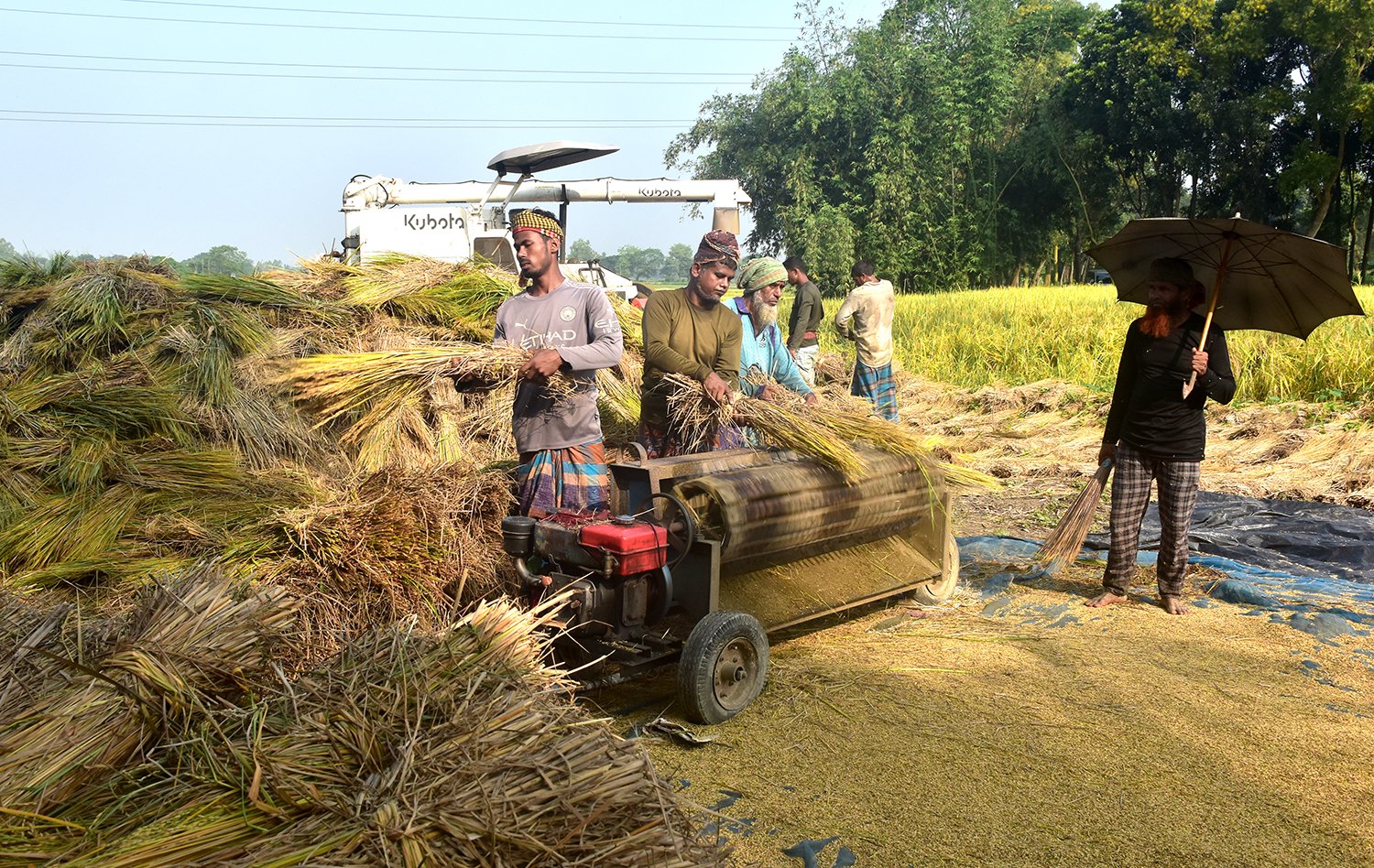
The arrival of late autumn brings smiles to farmers’ faces as paddy cutting and threshing are now in full swing across the fields of Manikganj. This Aman harvest not only fills farmers’ homes with grain but also fuels a seasonal rural economy across the district. With the return of this vibrant farming period, Manikganj’s agricultural sector has once again come to life. According to the Department of Agricultural Extension (DAE), the Aman season is expected to generate trade worth nearly Tk 330 crore this year.
All seven upazilas of Manikganj have witnessed bumper Aman paddy production. Both transplanted and broadcast Aman were cultivated on a large scale across the district. As per the DAE, during the 2025-26 fiscal year, transplanted Aman was grown on 13,238 hectares of land, 1,170 hectares more than last year. In addition, broadcast Aman cultivation covered 18,561 hectares. Favourable weather conditions have resulted in yields of 17-20 maunds per bigha for transplanted Aman.
Farmers enjoyed a season with timely irrigation, fewer pest attacks, and ideal weather factors that together ensured one of the highest yields in recent years. Beyond paddy, straw sales have become a significant source of income this season, with each bigha of straw selling for Tk 7,000-8,000. However, the cost of cultivation has risen by nearly 40 percent over the past few years. Expenses for fertilizer, irrigation, pesticides, and labour have all increased, while paddy prices have not kept pace. Farmers now spend Tk 13,000-15,000 per bigha on cultivation. The use of harvesters, however, has reduced cutting costs by about Tk 2,000 per bigha providing some relief.
Farmers across the district are excited about this year’s bumper harvest. Rahman Miah, a farmer from Hatipara village in Manikganj Sadar, said, “The weather was perfect throughout the season. Sunlight, water, everything was in our favour. I harvested 18 maunds per bigha. The price could have been a little higher, but I’m still satisfied since the yield was good.”
Khokan Hossain, from the same village, echoed similar concerns. “Production costs have increased by almost 40 percent in recent years. Fertilizer, irrigation, pesticides, labour everything is costly now, but the price of paddy hasn’t increased accordingly. I spent Tk 13,000-15,000 per bigha. After selling the paddy and straw, I made Tk 13,000-14,000 profit per bigha.”
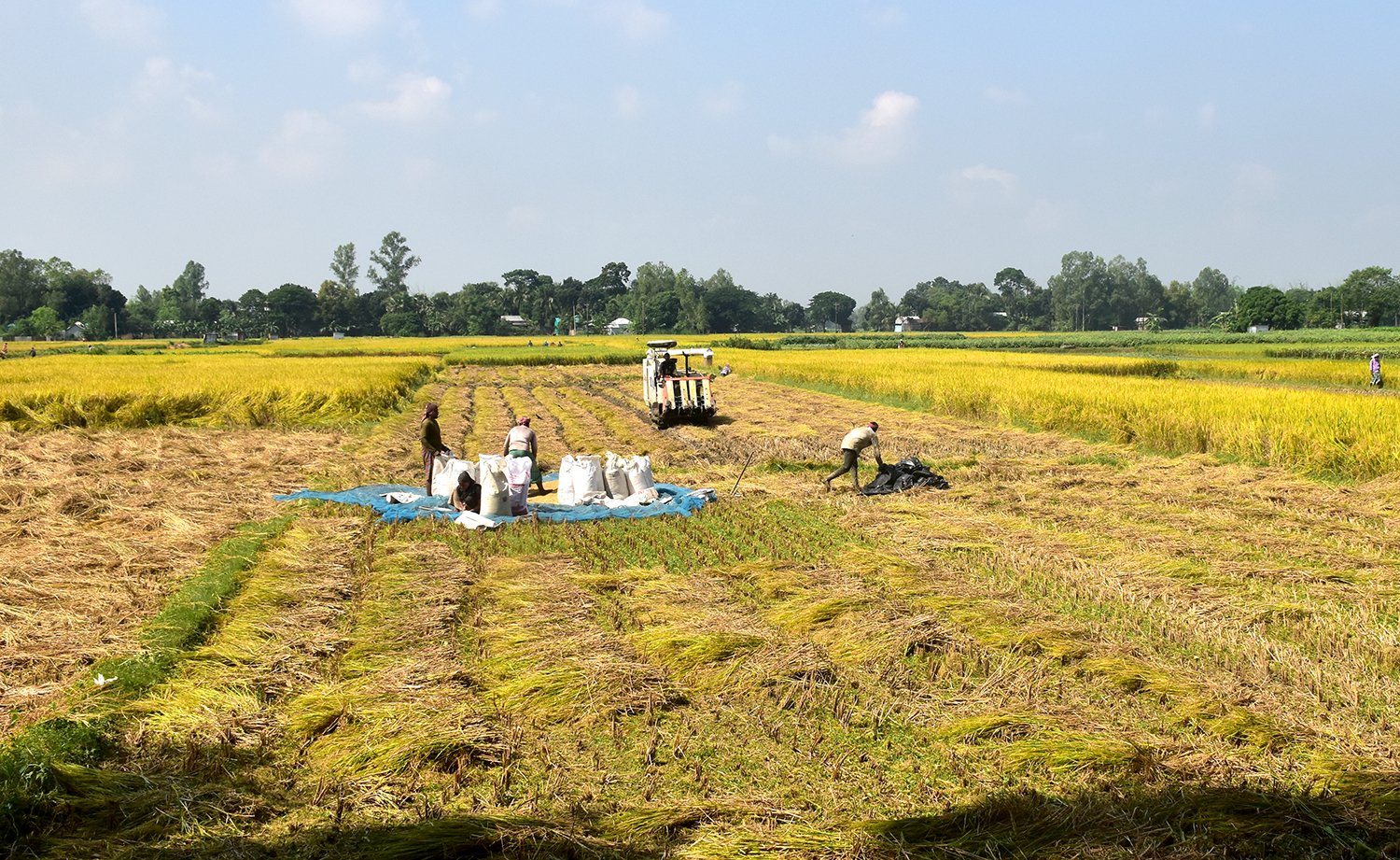
In the Kamta village of Saturia, farmer Abdul Hai said, “For the past two years, storms and heavy rains damaged my crops. This year, I harvested 50 maunds from three bighas. I also sold straw worth almost Tk 20,000. After many setbacks, this harvest feels like a fresh start.”
Another farmer from the same village, Ramzan Ali, said, “This year’s yield made us really happy. I got 17-18 maunds per bigha. But fertilizer, pesticides and irrigation costs are very high. Straw prices saved us this season. We want the government to raise paddy prices.”
Solim Uddin from the Fukurhati area added, “Without machines, it wouldn’t be possible to harvest so quickly and cheaply. I got about 90 maunds from five bighas. If the price increases a little, the entire season will be profitable.”
Shahjahan Siraj, Deputy Director of the Department of Agricultural Extension in Manikganj, said, “Aman production has been excellent this year. Weather conditions were favourable, and farmers took proper care of their fields. With both paddy and straw sales, farmers genuinely benefited this season. If we can reduce cultivation costs a bit more, this autumn period will truly become festive for them.”