
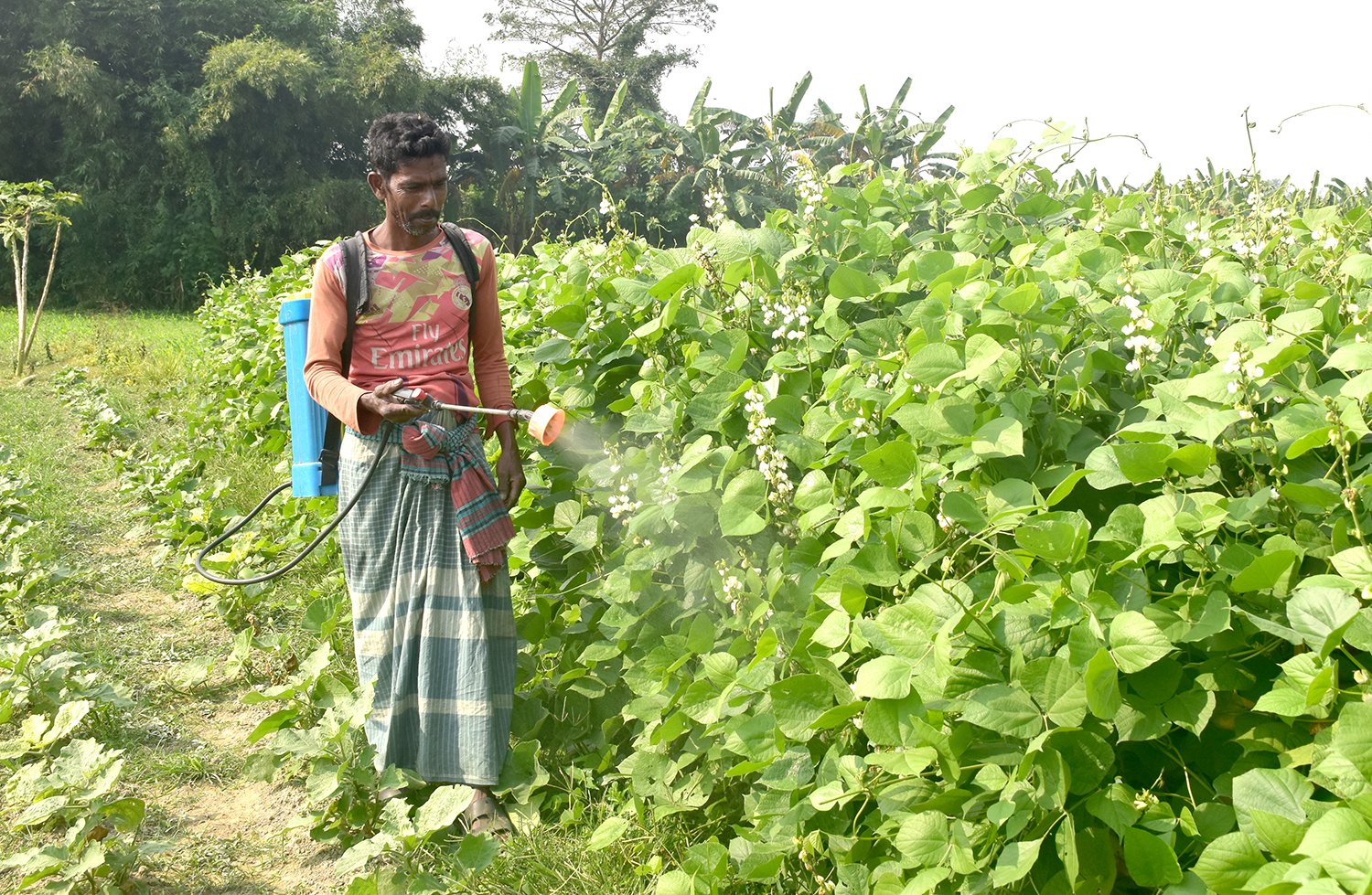
In the agriculture-dependent district of Manikganj, various pesticides are still used indiscriminately. Misinformation, aggressive sales tactics by traders, and a lack of awareness are pushing farmers toward increasing dependency on chemical pesticides. Although nearly five lakh farmers in the district use powerful pesticides regularly, most remain unaware of the long-term health risks or the damage they cause to soil and the environment. Experts warn that excessive pesticide use is turning into a silent crisis.
Anwar Hossain from Syedpur village in Manikganj Sadar Upazila has been farming for more than 30 years. On his one-bigha field, he grows eggplants and beans and sprays pesticides regularly. He knows the health risks but says he has no alternative.
“If you want good yields, there is no option without pesticides. It touches my skin, the smell gives me headaches, but I cannot stop working,” he says. “I have to spray three times a week. If I skip even once, the flowers and fruits fall off. I’ll need nearly 20,000 taka worth of pesticides for this single bigha. Without it, the crops won’t survive.”
Like Anwar, almost five lakh farmers in Manikganj are facing the same reality, spraying pesticides two to three times a week for better pest control and higher yields.
Shahar Ali, another farmer from Syedpur, has been farming for over four decades. He recalls a different time: “In the past, we didn’t need fertilizer or pesticides. The river brought water and silt, and the soil stayed fertile. But years of chemical fertilizer and pesticide use have drained the soil. Still, at this age, how can I leave farming? Everyone uses pesticides for higher yields. When I go to the pesticide shop, they simply give me whatever they think is right, and I use it. Sometimes, if I spray a little too much or use it at the wrong time, the entire crop is damaged. We take all the risks, and the expenses are huge.”
Almas Molla from Fokurhati village in Saturia Upazila shares the same frustration. “I planted eggplant and beans on one bigha. I thought I would earn well, but now I spend around 1,600 taka a week just on pesticides. On top of that, I need to hire someone to spray, and sometimes, day labourers aren’t available. If I don’t spray two or three times a week, the leaves curl and pests attack. After all this cost, the market price is often poor. Farmers like us are trapped, use more poison, spend more money, but earn less.”
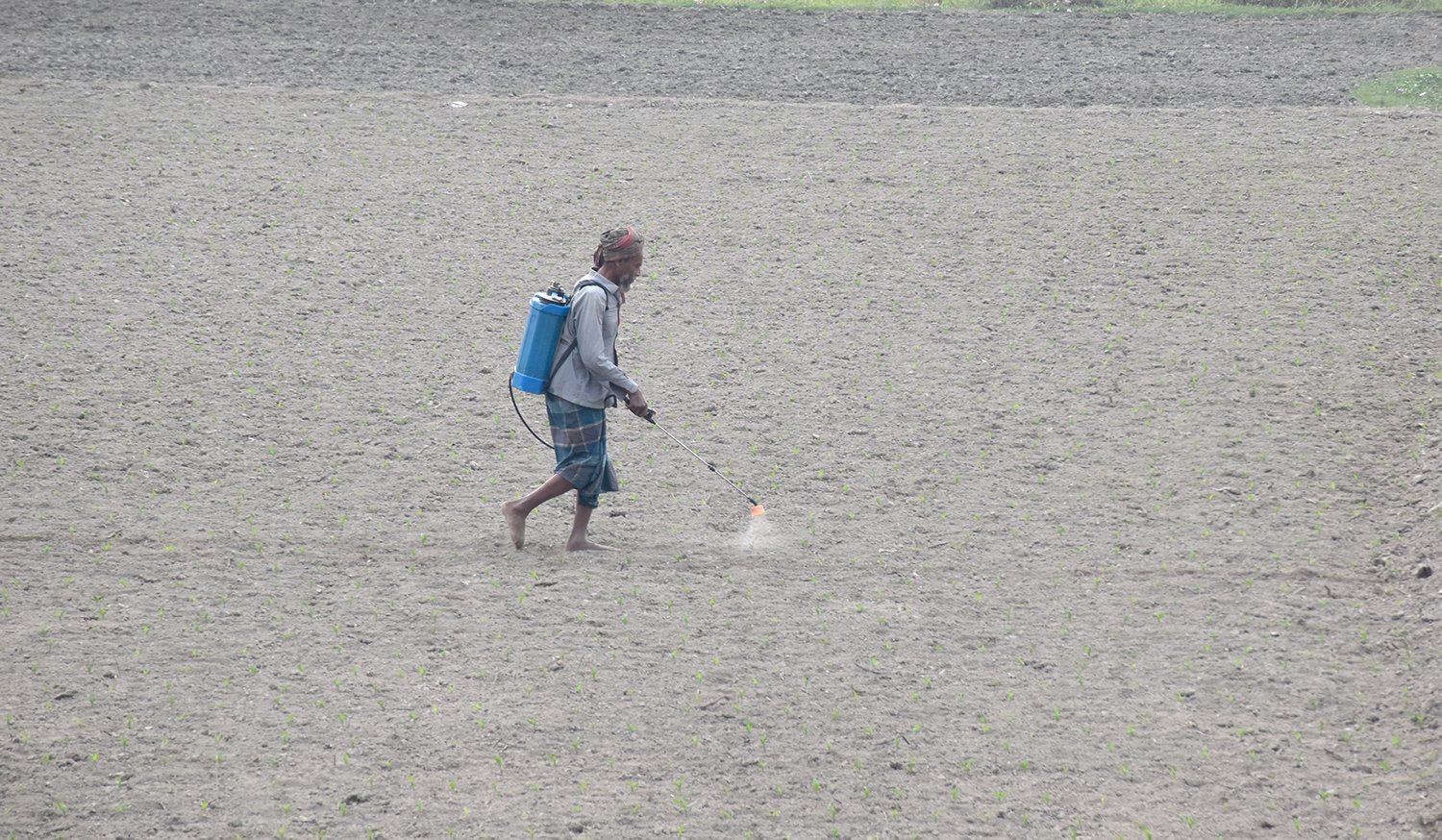
Ripon Hossain from Kamta village says, “Modern farming doesn’t work without pesticides and fertilizers. Our fathers used to farm at very little cost, but now pests are so aggressive that crops won’t survive without chemicals. Buyers don’t want vegetables with even a small mark or insect bite. To meet their expectations, we must spray at least twice a week. We are scared to work in the fields, but if we stop farming, how will we feed our families? We are now fully dependent on chemicals.”
His neighbour, Moktar Hossain, adds: “Without pesticides, vegetables won’t last. Good eggplants sell for 40–50 taka a kg, but if they’re slightly bent or insect-damaged, they barely fetch 10–15 taka. If we don’t earn enough, how will we survive? We also want to grow crops without chemicals, but the yields drop, and pests destroy everything. It feels like we have become slaves to pesticides. Every year the amount increases, the costs rise, yet the profit keeps shrinking.”
Environmental activist Bimal Chandra Roy warns, “In the race for higher yields, pesticide use is rising sharply. We must ask how safe these vegetables are and what this means for biodiversity. Farmers cannot escape this cycle alone; there must be coordinated efforts. Local, natural, and sustainable methods must return. Otherwise, soil fertility will continue to decrease, and beneficial insects will disappear.”
Dr Manabendra Sarkar Manab, Junior Consultant of Medicine at the Manikganj 250-bed General Hospital, says pesticide toxicity poses serious threats: “Long-term exposure to pesticide chemicals can cause cancer, liver disease, neurological disorders, and respiratory problems. Farmers who handle these chemicals daily are at the highest risk. And when we consume these pesticide-treated vegetables, we too may develop kidney problems or even cancer.”
Shahjahan Siraj, Deputy Director of the Department of Agricultural Extension (DAE), says stricter regulations are being introduced: “Farmers usually buy pesticides directly from shops. Sometimes we receive reports of crop damage due to excessive use. The government has decided that new pesticide license holders must have at least an SSC qualification and will receive training before getting a license. Retailers will not be allowed to sell pesticides without prescriptions from our field officers. We hope these steps will reduce misuse. We are also encouraging farmers to adopt IPM, pheromone traps, and organic methods.”
To ensure safe food, safe farming must come first. And that begins with correct information, proper safety practices, and increased awareness. World No Pesticide Use Day reminds us that fields need knowledge not poison, to protect both people and the environment.