

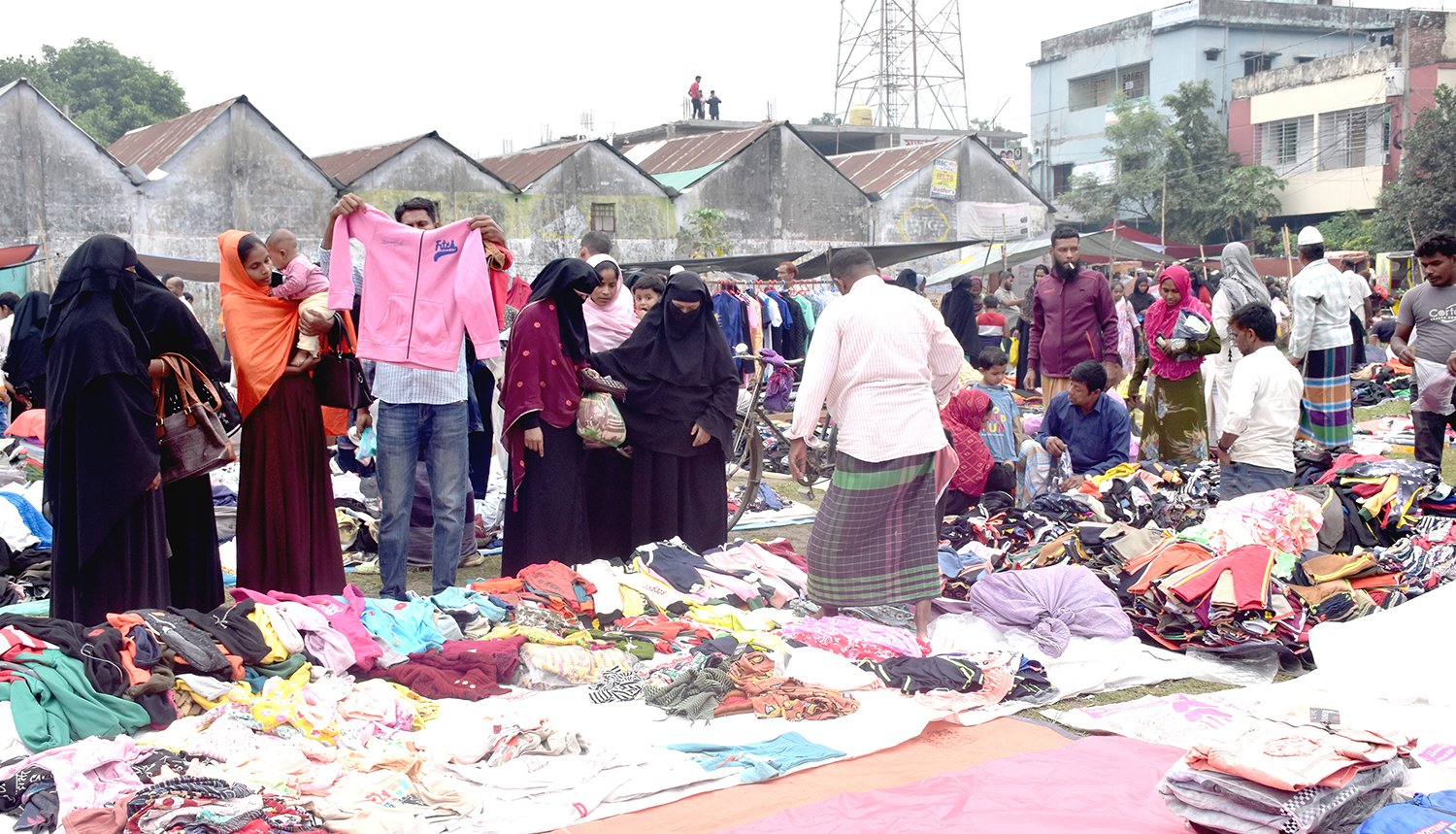
As the cold intensifies across Manikganj over the past several days, demand for warm clothing has surged sharply. While affluent and middle-class families crowd shopping malls and branded stores, low- and lower-middle-income people are turning to a more affordable alternative, the old clothes haat of Singair. The once grain-famous Singair Haat has now transformed into a bustling winter marketplace, offering warmth at prices within reach of the poor.
From sweaters and jackets to blankets, baby clothes, caps, and socks, the open-air market is witnessing an overwhelming crowd as temperatures continue to drop.
Located at the Singair Government Pilot High School grounds, the market operates under the open sky twice a week, on Thursdays and Sundays. Although the haat was once known for paddy and jute trading, it has now gained popularity mainly for old and low-cost winter garments.
Read More: No Repair in 22 Years: Ashrayan Houses Near Collapse
A visit to the market reveals rows of temporary stalls selling clothes priced from as low as 10 taka to as high as 500 taka. Due to this wide price range, the market attracts people of all ages and income levels, with the majority coming from lower-income households.
Rahman Munshi from Jamitta village came to the market with his grandson Arafat. “Winter has started, and my grandson will suffer if he doesn’t have warm clothes,” he said. “I bought a hoodie for 80 taka and a sweater for 170 taka. If I went to a shop, it would cost much more. For people like us, this market is the only option.”
Santa Sultana, a housewife from Joymontop village, was seen carefully selecting baby clothes. “My baby is only one year old. In winter, babies need many clothes,” she said. “Here I bought ten pants for 100 taka and ten T-shirts for 250 taka. In the market, these would cost more than 500 taka. Many women like me come here to save money.”
Read More: 400 Km of Manikganj Roads Unusable
Another buyer, Abdul Karim, a day labour from Singair Bazar, shared a similar experience. “I earn daily wages. Buying new jackets is impossible for me,” he said. “Here I bought two hoodies and one jacket for 400 taka. As long as I search carefully, I can find good-quality clothes.”
Seller, Almas Hossain, who has been trading here for four years, said the market hosts between 200 and 250 sellers. “We sell sweaters, jackets, tracksuits, children’s clothes, shawls, and blankets,” he explained. “Each seller specialises in different items. Currently, sales per market day range between 1 to 1.2 million taka.”
Another seller, Rocky Ahmed, described the market as a “trusted place for low-income people.” He said, “Those who cannot afford new clothes come here. Middle-income buyers also shop here. Women customers are especially high. Good-quality women’s winter clothes are available between 50 and 200 taka. As winter deepens, more designs and items will arrive.”
Selim Mia, who sells blankets, added that demand has doubled in recent days. “Because of the continuous cold, people are buying more blankets. Many customers buy multiple items at once for family members,” he said.
Mohammad Atowar, president of the Singair Bazar Traders Association, said the market plays a vital social role. “This is a very old hat held twice a week on the school field,” he said. “Most stalls are temporary, and trading continues from 10 am till evening. For low-income people, this old clothes market is their main source of winter clothing. Every market day sees several lakh taka in transactions.”