

The impact of ongoing instability in the Middle East is no longer confined to the global energy market. It is now beginning to affect the agricultural sector as well. Rising international prices of raw materials used in chemical fertilizers have increased production costs for farmers in Bangladesh. In response, more than 2,500 farmers in Singair Upazila of Manikganj are gradually turning to eco-friendly farming practices as an alternative to chemical fertilizers and pesticides.
Bangladesh requires nearly 6.8 million tonnes of chemical fertilizers annually, around 80 percent of which are imported. As a result, fluctuations in global prices and supply disruptions directly affect the country’s agriculture sector, with marginal farmers suffering the most.
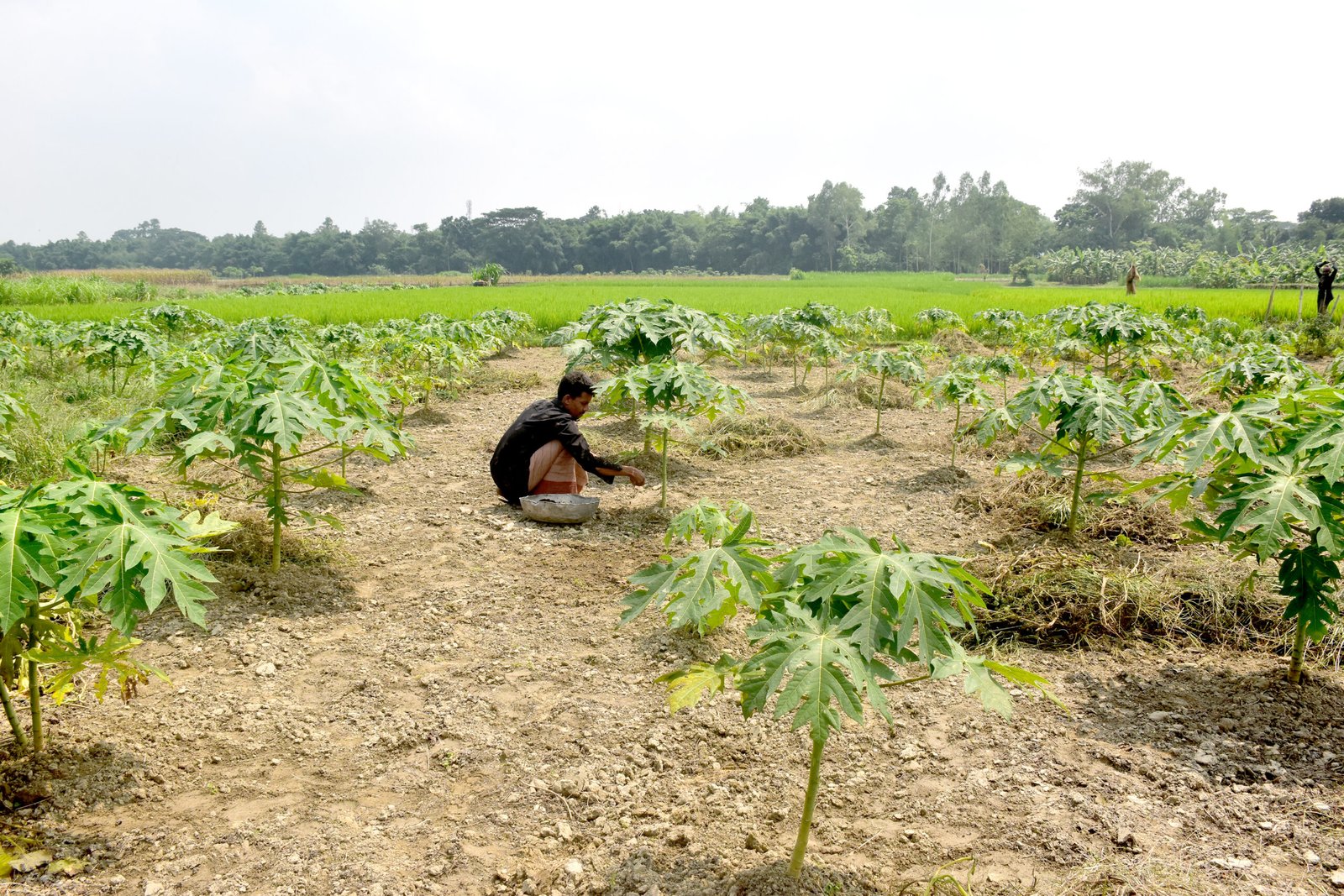
Farmer Munnaf Hossain from Kanainagor village in Singair has been cultivating vegetables commercially for nearly a decade. Every year, he grows papaya, bitter gourd, okra, cucumber, eggplant, and bottle gourd on five to six bighas of land. While he once relied entirely on chemical fertilizers and pesticides, a large portion of his farmland is now cultivated using organic fertilizers and natural pest control methods.
“Previously, I had to spend between Tk 20,000 and Tk 25,000 per bigha only on fertilizers,” said Munnaf Hossain. “After receiving training, I learned how to reduce the use of chemicals in farming. Now I produce vermicompost and tricho-compost using manure from my 13 cattle. This has significantly reduced my dependence on chemical fertilizers and improved soil health.”
Munnaf is not alone. A total of 2,520 farmers from four unions in Singair upazila are gradually moving away from chemical-based farming. Under the “Green Evolution” project implemented by WAVE Foundation, farmers are receiving training and technical support on eco-friendly agricultural practices.
Inspired by Munnaf, neighboring farmers Gias Uddin and Lutfur Rahman have also started producing organic fertilizers. Gias Uddin said the fertilizer crisis has become severe in recent times.
“Fertilizers are not always available on time, and prices have gone up sharply,” he said. “Earlier, I used to spend around Tk 15,000 on fertilizer for one bigha of land. Now, with organic fertilizer, I can manage within Tk 2,000 to Tk 3,000. Production costs have decreased, and the demand for vegetables grown in my field has also increased.”
Sharmin Akter, a homemaker from Char Charavanga village in Bayra union, has also embraced eco-friendly farming after receiving training. She established a vermicompost plant at her home and uses the organic fertilizer on her own farmland. In addition, she has developed a nutrition garden based on six food groups, producing a variety of vegetables on her homestead.
“For the past year, I have completely stopped using chemical fertilizers,” she said. “I now use vermicompost on all my land. The vegetables produced on my farm are safe, and they are also getting better prices in the market.”
Farmer Pintu Mahmud from Goalbathan village in Joymontop union said rising fertilizer prices have become a major burden for farmers.
“A sack of fertilizer that used to cost Tk 1,350 now costs around Tk 1,700,” he said. “We are forced to buy it because crop yields decline without fertilizer. However, due to the ongoing shortage, I have started using organic fertilizer. I recently cultivated cucumber and eggplant on one bigha of land using only organic fertilizer.”
Another resident of the same union, Sumi Akter from Fakirpara village, has built a vermicompost plant beside her home. Her father is now using organic fertilizer in their vegetable fields, reducing fertilizer costs by more than half. She hopes to use organic fertilizer on all two bighas of their land during the upcoming winter season.
Md. Ishtiaq Islam, Agroecology Specialist of the Green Evolution project, said the initiative has trained 2,520 farmers in four unions of Singair on safe vegetable cultivation and cost-effective farming methods.
“Our goal is to ensure safe food production while reducing the use of harmful chemicals,” he said. “We are also providing farmers with continuous technical assistance.”
Medical experts warn that excessive use of chemical fertilizers and pesticides poses serious health risks. Dr. Manabendra Sarkar Manab, Junior Consultant (Medicine) at Manikganj 250-Bed General Hospital, said prolonged exposure to toxic chemicals can increase the risk of cancer, liver disease, neurological disorders, and respiratory complications.
“Farmers and field-level workers who regularly handle these chemicals are the most vulnerable,” he added.
According to Shahjahan Siraj, Deputy Director of the Department of Agricultural Extension in Manikganj, many farmers apply excessive amounts of fertilizers and pesticides without proper guidance from agricultural officials.
“This damages soil health and increases production costs,” he said. “Manikganj has an annual demand for around 88,000 metric tonnes of chemical fertilizer, whereas only 3,000 to 4,000 metric tonnes of organic fertilizer are produced locally. Increasing organic fertilizer production could significantly reduce dependence on chemical fertilizers.”
He further said the department is encouraging farmers to use vermicompost and tricho-compost in order to lower production costs and ensure safe vegetable production.
“As part of our regular activities, we are providing farmers with advice and support to expand the use of organic fertilizers,” he added.
At a time when Bangladesh’s agriculture sector is facing mounting challenges from fertilizer shortages, rising production costs, and climate change, the initiatives taken by farmers in Singair are presenting a promising alternative. Experts believe that with proper training and institutional support, eco-friendly farming could become one of the key foundations of sustainable agriculture in the future.